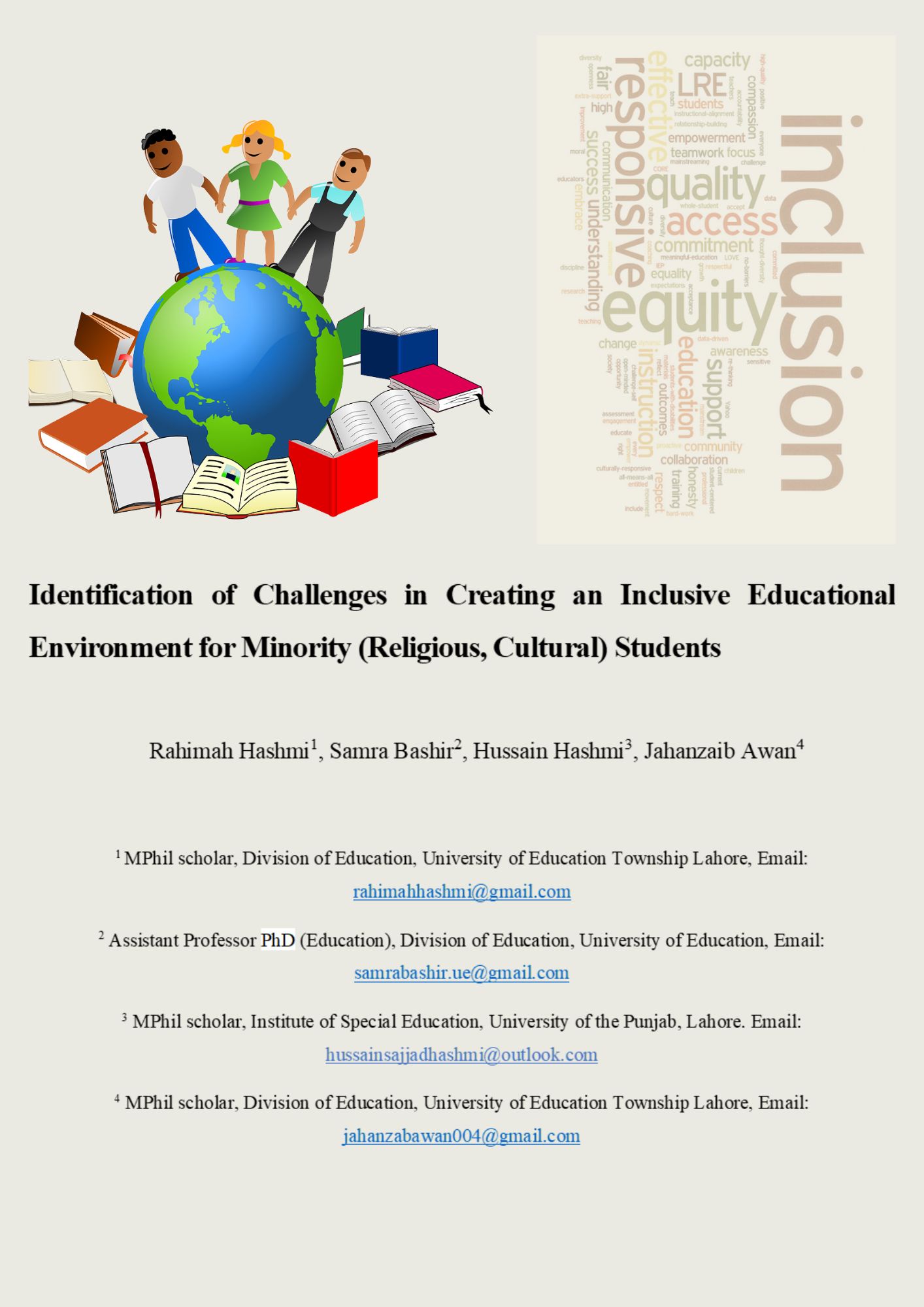
Identification of Challenges in Creating an Inclusive Educational Environment for Minority (Religious, Cultural) Students
DOI:
https://doi.org/10.21015/vtess.v11i2.1513Abstract
Inclusive education has become a global priority to ensure equal educational opportunities for all students, regardless of their backgrounds. The study highlights gaps in existing programs and stresses the need for diverse perspectives and strategies to promote inclusivity in Pakistan. This study uses a quantitative descriptive survey approach to examine the challenges that minority students encounter in achieving inclusivity in education. A survey is administered to minority students (religious & cultural) to gather data on their perceptions on five factors discrimination in the classroom, inadequate teacher training/ lack of cultural and religious sensitivity in teaching, lack of representation, lack of inclusive curriculum and language barriers. Descriptive statistics will analyze data to identify challenges for minority students in creating an inclusive educational environment. The study will recommend ways to promote inclusivity in education for minority students in Pakistan. The study highlights the significance of teacher training, curriculum development, and addressing challenges for improvement in creating inclusive learning environment.
References
Babbie, E. R. (2012). The Practice of Social Research (13th ed., illustrated). Cengage Learning.
Banks, J. A. (2001). Cultural Diversity and Education: Foundations, Curriculum and Teaching. Boston: Allyn & Bacon.
Burdi, Mukhtiar & Khan, Maryum & Khan, Muhammad. (2018). Exclusion of religious minorities from national curriculum of pakistan.
CAST (2018). Universal Design for Learning Guidelines version 2.2.
Cochran-Smith, M., & Zeichner, K. M. (2005). Studying teacher education: The report of the AERA panel on research and teacher education. Lawrence Erlbaum Associates.
Costello, S., & Boyle, C. (2013). Pre-service secondary teachers' attitudes towards inclusive DOI: https://doi.org/10.14221/ajte.2013v38n4.8
education. Australian Journal of Teacher Education (Online), 38(4), 129-143.
Dayan, U., Khan, M. N., & Ali, A. (2017). The Experience of Being A Minority Group Member: The Case Of Four Christian Students In Pakistan. Pakistan Annual Research Journal, 53(1), 137-156.
Friend, J. (2007). A Review of: “White Teachers/Diverse Classrooms: A Guide to Building Inclusive Schools, Promoting High Expectations, and Eliminag Racism”. Multicultural Perspectives, 9(2), 38-39. doi: 10.1080/15210960701228789.
Gill, F. (2006). Attitude of secondary level Christian students toward Muslim Teachers at convent Girls high school, Okara. Thesis, University of Education.
Goddard, C., & Evans, D. (2018). Primary pre-service teachers' attitudes towards inclusion across the training years. Australian Journal of Teacher Education, 43(6), 122-142.
Iqbal, S., Ahmad, R., & Ayub, N. (2013). Self-esteem: a comparative study of adolescents from mainstream and minority religious groups in Pakistan. Journal of immigrant and minority health, 15, 49-56. DOI: https://doi.org/10.1007/s10903-012-9656-9
Kennette, L., & Lin, P. (2021). Creating an inclusive learning community to better serve minority students. Journal of Education, Technology, and Higher Education, 4, 1-18. https://doi.org/10.36021/jethe.v4i3.250
Malik, Dr.Khuda. (2014). Discrimination and problems of Religious Minority Students in Public Schools of Pakistan.
Malik, I. H. (2002). Religious minorities in Pakistan (Vol. 6). London: Minority Rights Group International.
Mathers N, Fox N, Hunn A. Surveys and Questionnaires. The NIHR Research Design Service for the East Midlands / Yorkshire & the Humber, 2009. http://www.rds-yh.nihr.ac.uk/wp-content/uploads/2013/05/12_Surveys_and_Questionnaires_Revision_2009.pdf accessed 19 May 2023.
Monje, L. D. (2017). General education teachers' attitudes about inclusion (Doctoral dissertation), Western Michigan University. Retrieved from https://scholarworks.wmich.edu/cgi/viewcontent.cgi?article=4110&context=dissertations
Nayyar, A.H., Salim, A. (2003). The Subtle Subversion: The State of Curricula and Textbooks in Pakistan.
Nazakat. (2016). Issues of Language in Education in Pakistan. Gandhara Journal of Research in Social Science, 1(1), 1. ISSN: 2415-2404.
Parveen, Z., Batool, S. B., & Arif, A. (2022). Attitudes and Concerns towards Inclusive Education in Pakistani Context: Pre-Service Teachers’ Perspectives. Human Nature Journal of Social Sciences, 3(4), 82-91.
Sultan, S. (2020). Importance of pre-service teacher training and need of time to strengthen at national level. Sir Syed Journal of Education & Social Research, 3(3), 326-334. doi: https://doi.org/10.36902/sjesr-vol3-iss3-2020(326-334).
Thomas, L. (2021). #Ibelong: Towards a sense of belonging in an inclusive learning environment. Widening Participation and Lifelong Learning, 23, 68-79. https://doi.org/10.5456/WPLL.23.3.68
UNESCO (2017). A guide for ensuring inclusion and equity in education. Paris: UNESCO. https://unesdoc.unesco.org/ark:/48223/pf0000248254.
Ydo, Y. (2020). Inclusive education: Global priority, collective responsibility. Prospects, 49, 97-101. https://doi.org/10.1007/s11125-020-09520-y.
Downloads
Published
How to Cite
Issue
Section
License
Authors who publish with this journal agree to the following terms:
- Authors retain copyright and grant the journal right of first publication with the work simultaneously licensed under a Creative Commons Attribution License (CC-By) that allows others to share the work with an acknowledgment of the work's authorship and initial publication in this journal.
- Authors are able to enter into separate, additional contractual arrangements for the non-exclusive distribution of the journal's published version of the work (e.g., post it to an institutional repository or publish it in a book), with an acknowledgement of its initial publication in this journal.
- Authors are permitted and encouraged to post their work online (e.g., in institutional repositories or on their website) prior to and during the submission process, as it can lead to productive exchanges, as well as earlier and greater citation of published work (See The Effect of Open Access).

This work is licensed under a Creative Commons Attribution License CC BY